
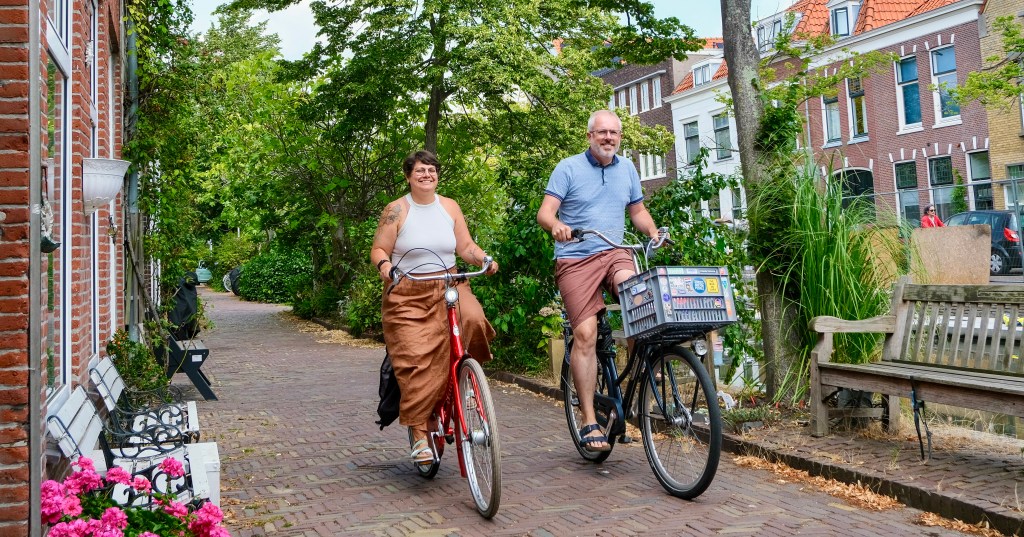
By Melissa & Chris Bruntlett
The following essay was co-authored with my husband and partner Chris Bruntlett following some deep discussions about where our work first started.
A decade and a half ago, we stumbled into this work with little more than a conviction that cities could be better. Not perfect or utopian, but better.
We believed that our children should be able to travel independently. That our parents should be able to remain active and connected as they age. That public spaces should invite people to linger rather than hurry through them. That transportation systems should offer freedom, not dependency. And that cities function best when they are designed around human beings rather than machines.
What we didn’t realise at the time was the way we communicated these ideas would prove to be just as important as the ideas themselves.
Over the years, we’ve often been asked how we have managed to remain optimistic in a field that can be so polarised, frustrating, and slow-moving. The answer is surprisingly simple: we made a conscious decision to practice what we’ve come to call “gentle advocacy.” But don’t let the name fool you: gentle advocacy isn’t passive, it’s not timid, and it certainly isn’t devoid of conviction.
Rather, it is the belief that lasting change is more likely to emerge from inspiration than indignation. That people are more willing to embrace a new future when they can clearly see themselves in it. And a belief that showing what is possible is often more effective than endlessly cataloguing what is wrong. But this approach can sometimes feel out of step with the times.
Modern discourse rewards outrage. Social media amplifies conflict. Algorithms elevate the sharpest criticism, the most cutting remark, and the most uncompromising position. It is often easier to gain attention by opposing something than by building support for something else. Easier to criticise than create, to enrage than inspire, and to present problems rather than solutions.
Still, after more than fifteen years of advocacy, writing, speaking, and working alongside communities around the world, we remain convinced that hope is the more powerful force. Not because hope is naïve, but because it is practical.
Decision-makers don’t need another person telling them why something can’t be done. They’re already surrounded by constraints, competing priorities, and political risk. What they need are examples, evidence, and stories: a vision of what success looks like. Our role has never been to win arguments; it has been to expand imaginations.
That’s why we’ve spent so much of our careers documenting places that have found solutions instead of obsessing over places that haven’t. Why we focus on what works. Why we tell stories about children cycling to school, older adults maintaining their mobility, neighbourhoods transformed by safer streets, and communities rediscovering public space.
People rarely change because they’ve been humiliated into agreement. They change because they’ve been shown a better way. And not everyone wants to have a good-faith conversation. This realisation can be liberating.
Advocates often feel compelled to respond to every criticism, rebut every misconception, and engage every opponent. We’ve certainly fallen into that trap ourselves. But experience has taught us some arguments aren’t invitations to dialogue but rather invitations to distraction.
Every minute spent arguing with someone committed to misunderstanding your position is a minute not spent advancing your vision. Every ounce of energy devoted to bad-faith criticism is energy unavailable for people who are genuinely curious, genuinely undecided, or genuinely empowered to make change. You won’t convince everyone, and you don’t need to.
The most significant urban transformations of the past half-century weren’t achieved because every resident, journalist, politician, or commentator agreed. They happened because enough people believed in a compelling alternative and were willing to work together toward it. Progress has never required unanimity. It requires leadership, and that begins with vision.
So, our advice to the next generation of advocates is simple: spend less time fighting over the future and more time describing it. Paint a picture that people can see themselves inhabiting. Tell stories that connect policy to everyday life. Invite rather than exclude. Encourage rather than condemn. Demonstrate rather than lecture. Show rather than tell.
Focus your attention on those with the power to implement change and with the openness to imagine it. Speak directly to decision-makers. Help them understand not only what needs to change, but why that change will improve the lives of the people they serve. In our experience, the rest will take care of itself.
After fifteen years, we remain convinced that cities become better when we appeal to people’s aspirations rather than their fears. That influence is built through trust. That kindness is not weakness. Optimism, when paired with evidence and persistence, is one of the most transformative forces available to us.
In a world increasingly defined by outrage, choosing hope and approaching with empathy can feel radical. But we’ve seen where it leads. We’ve watched minds open, policies shift, streets transform, and communities flourish. That is why we continue to choose gentle advocacy. Not because it’s the easiest path, but because it’s the one that builds a brighter future.
 Modacity Creative
Leave a comment