
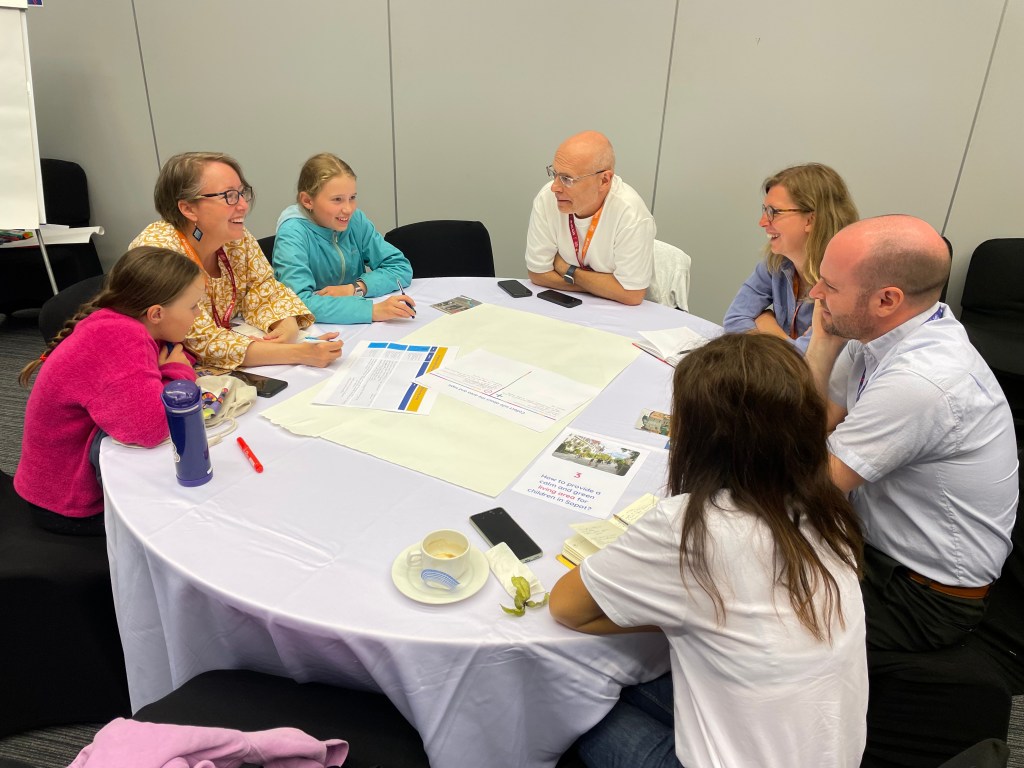
We all remember those lectures from our school days. Sitting in a dark room listening to a professor or instructor talk for an hour about the contents of the current study chapter and struggling to stay attentive while simultatneously making notes you hope will be relevant come exam time. Contrast those lessons with the ones where you got to test various concepts with your hands, building, drawing, or discussing complex ideas in a way that flexed your creative muscle. Of all the positive memores I have from my study days, those are the ones that stand out as having the most impact, and where I learned the most practical skills that I continue to use to this day (22 years later).
The Learning Never Stops
As a consultant who has delivered dozens of co-creation and capacity building workshops of the years, I have seen how this type of learning never really stops. I deeply enjoy providing inspirational keynotes to practitioners, advocates, and leaders around the world. What I have noticed is that when they are complimented by experiential learning that lets participants put their learnings into practice in scenarios that reflect their current challenges, you begin to see the light bulbs go on as they begin to understand how they can use this knowledge to improve their city.
The reality is that even the most seasoned expert has something new to learn. The world around us is constantly changing, with new and innovative practices coming forward that can positively impact the work of mobility and urban planning professionals. Having the humility to put ourselves in an unknown environment where our thinking may be challenged makes us better at what we do, because it stretches our understanding of the urban environment and what the people living in it need to thrive. We are also forced into scenarios where we must collaborate with people we may not know, or come from a different sector or background than we do. This then contributes to a more robust conversation, as we combine our various perspectives to address the task at hand.
Seeing the world through a different lens
In nearly every workshop I’ve facilitated, no mater how many maps, paper, markers, stencils and such there are, or how clear the brief is detailing the case study exercise, it always takes participants some time to get started. The only exception I’ve ever seen to this is children, whose imaginations are not yet overshadowed by years of adult practicalities. Often, participants needs some encouragement, and I may ask them what they’re discussing or envisioning. As they begin to describe in detail their ideas, I ask them to draw what they mean on the provided map or image. Once they get started, it frequently becomes challenging to get them to stop!
But what if you don’t have time to slowly get participants warmed up? A handy tip, and also a great way to get people energized after a presentation, is to go outside and see a space through the new lens of what they have just heard. Discussing how to improve accessibility on a street or corridor? Let’s view that street in real life. What limitations do they see? Where is the potential for improvement? When groups are tasked with reimagining the allocation of space for better walking and cycling, or the creation of a public space, before setting the markers to work, one of the best ways to inspire creativity is to stand in the space and feel what the current experience is like. Seeing the space with a different lens has the incredible capacity to spark concepts that wouldn’t have been possible without first sitting in the space.
Placing a value on hands-on training
So if we know that the learning never stops, and that seeing the world in a new way can make us better practitioners, how do we build that into our practices and daily work? The first step is valuing hands-on training. Thankfully, many employers regularly offer education and training budgets specifically for this purpose. Whether to attend a course, conference, or training, more and more organisations understand that to have a happy and productive team means giving them the opportunity to continue growing in their professional and personal capacity.
At the same time, there are professionals (like me) and teams that want to inspire and transfer knowledge to their professional colleagues in order to help create more vibrant and equitable public spaces. We are energized when we see professionals grasp a new idea or concept, and see precisely how they can adapt them to their community, town or city, province, and beyond. Ongoing learning doesn’t have to limited to your own geographic sphere of influence, and frequently there is a value of learning from other places that may do things differently, but can provide the foundational knowledge for change we are searching for.
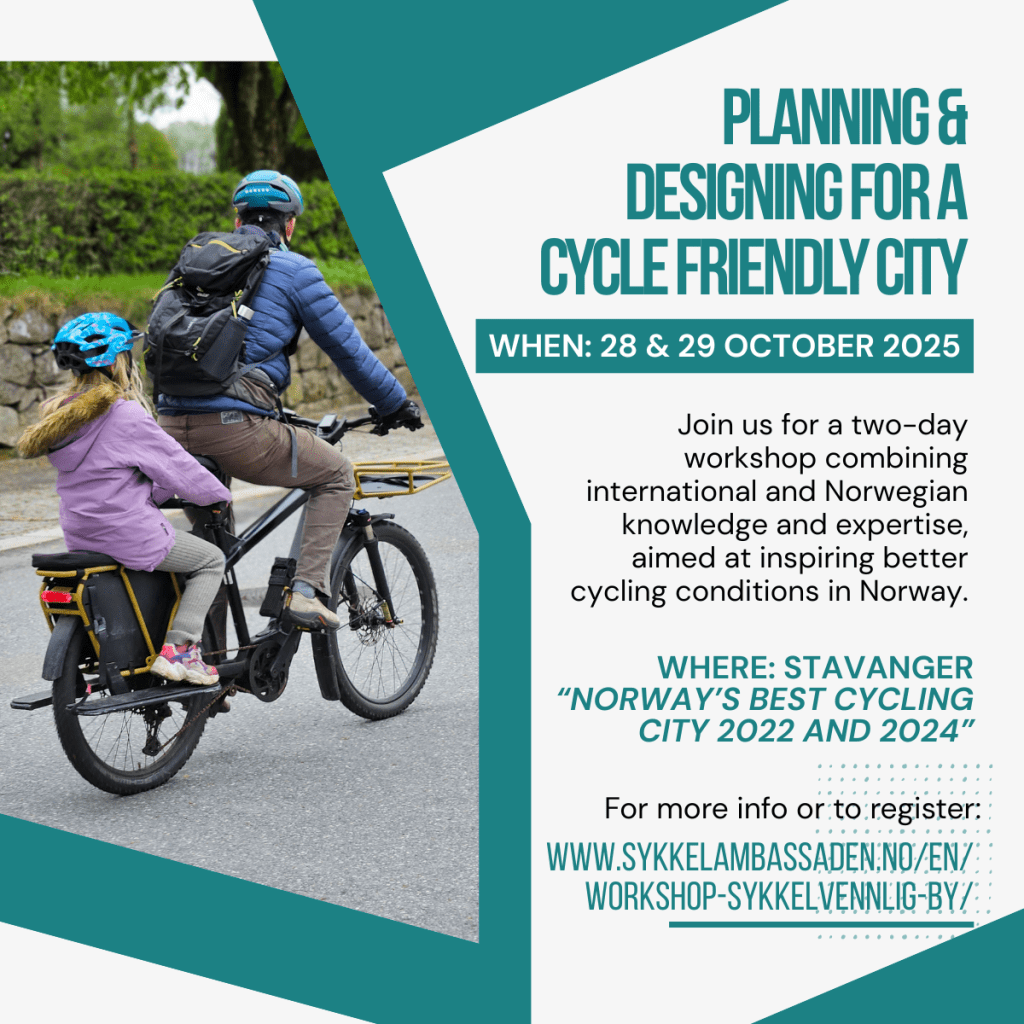
This Autumn, I am teaming up with my colleagues Monica Bikos, founder of Sykkelambassaden, and Mobycon Sustainable Mobility Consultant Robin van der Griend, to deliver a workshop combining all these elements. Planning & Design for a Cycle Friendly City is aimed at providing Nordic practitioners and professionals with the knowledge and skills they need to realise a more cycling-friendly future for their cities, complete with a site visit and hand-on application of ideas that can be translated to their local contexts. Set in Stavanger, Norway’s Cycling City, it’s the perfect backdrop to inspire participants to see their streets in a new way.
As I continue my own learning journey, I will continue to prioritise experiential training in my practice, understanding that they only way we create a future that is inclusive, equitable, and inviting for everyone, is to never stop challening ourselves. There’s always something we don’t yet know that will strengthen our work and more positively impact the lives of the most of us!
Interested in joining us for the Planning & Design for a Cycle Friendly City workshop in Stavanger? Click here for more information or to register.
 Modacity Creative
Leave a comment